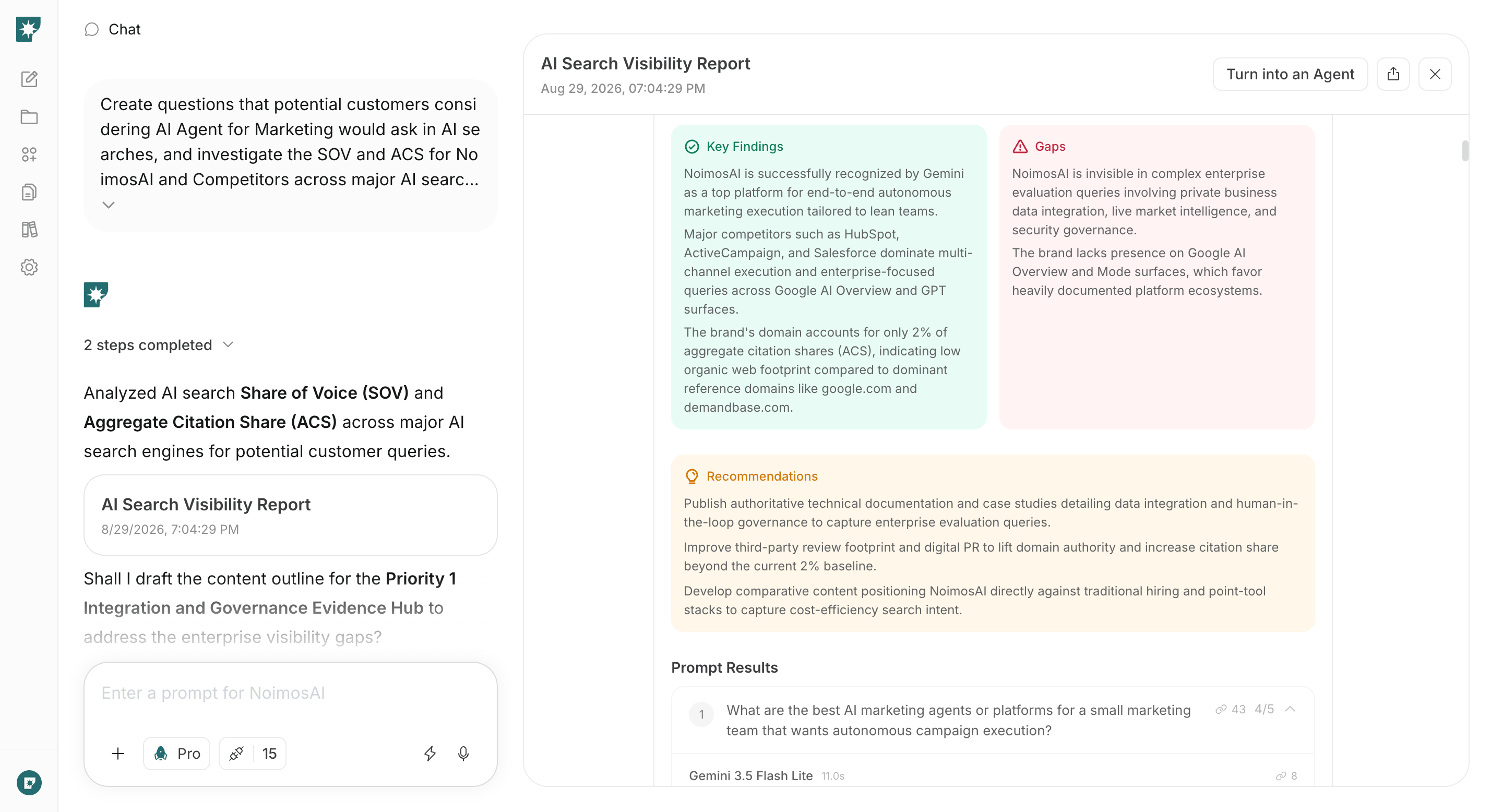
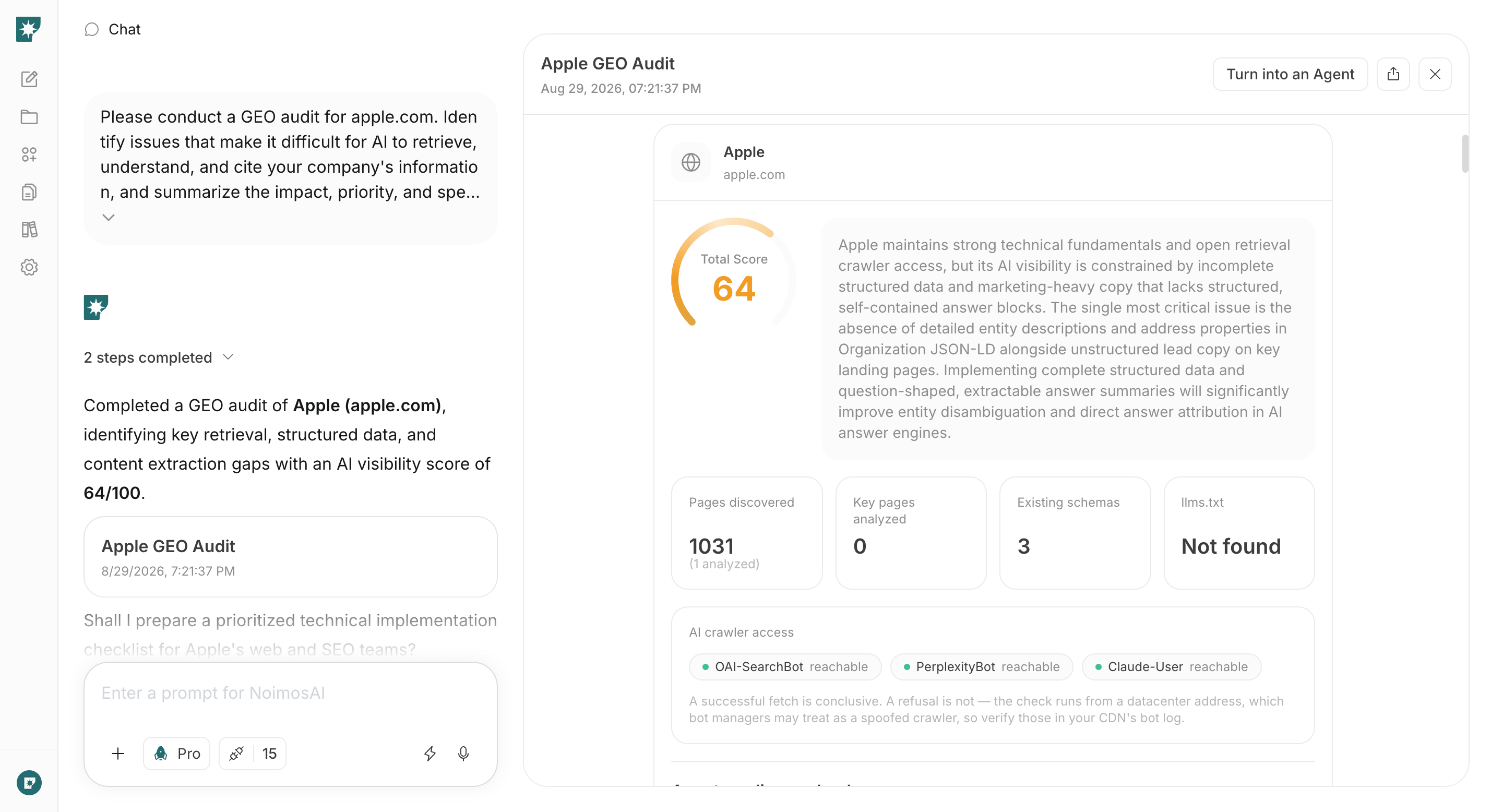
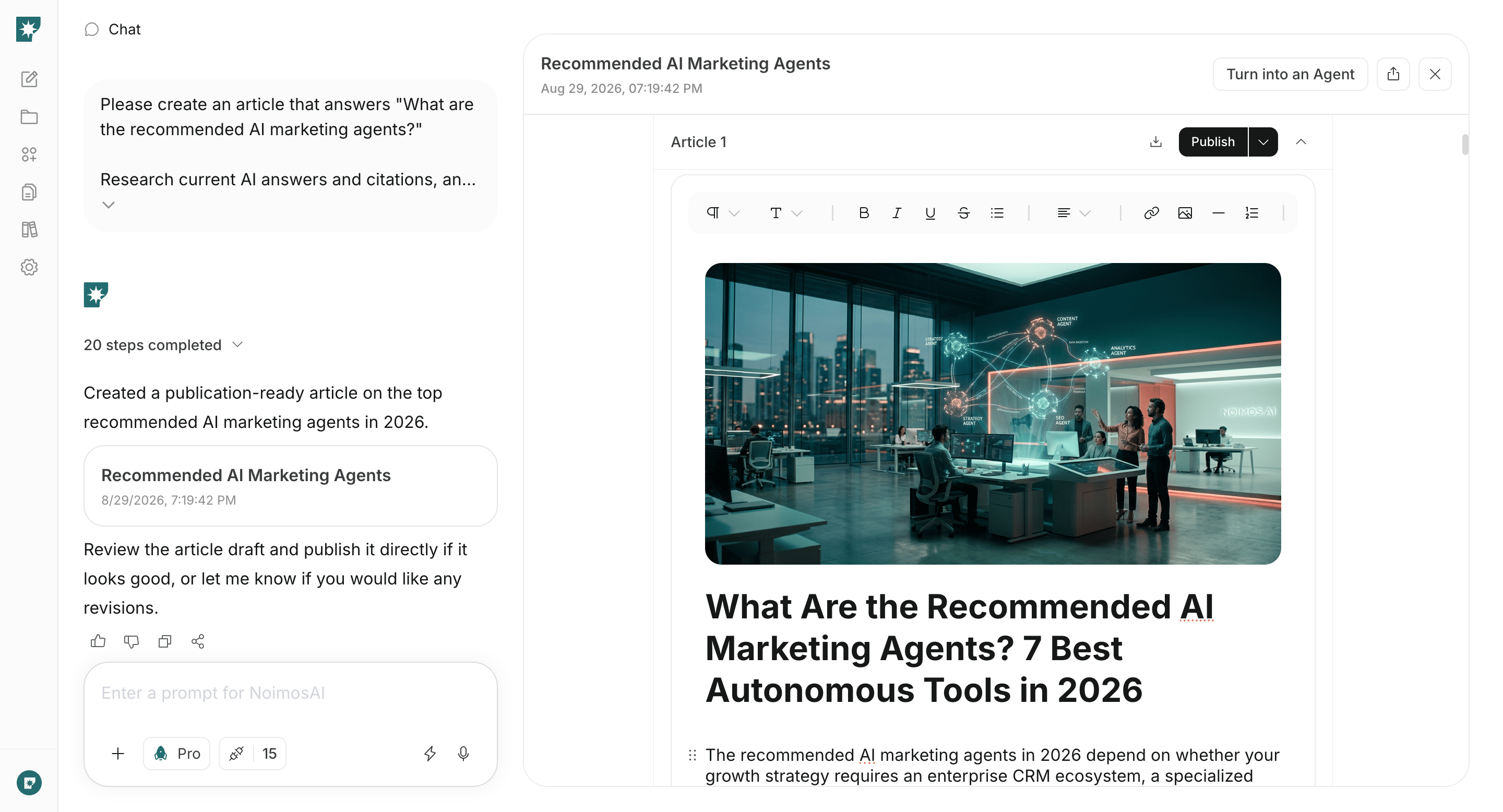
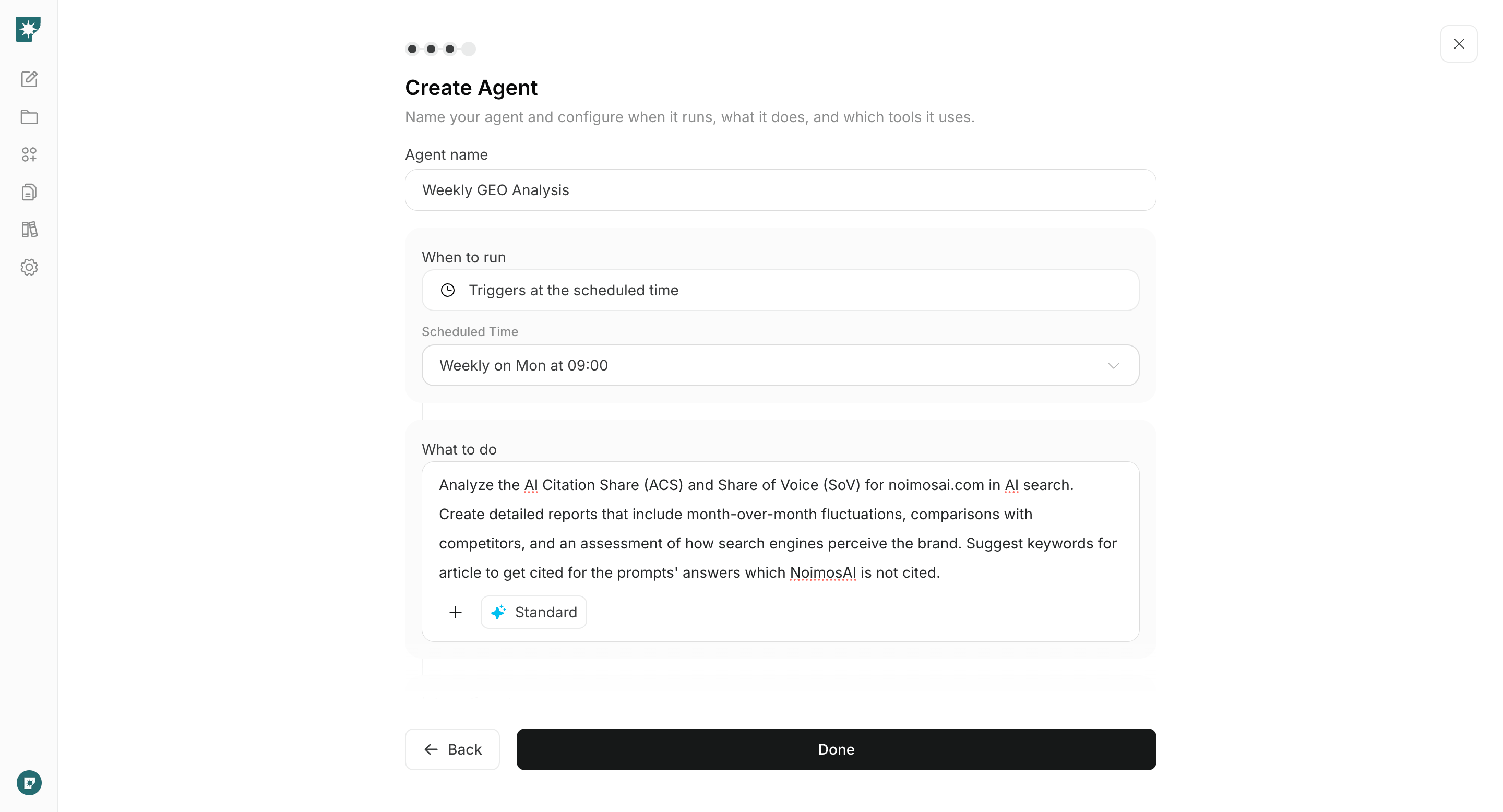
Use NoimosAI to increase the chances your authorship and content are accurately cited and referenced when AI answers questions about your topics.
increases the likelihood that AI answers use your original work as a source when readers ask about terminology, methods, comparisons, or current developments in your field. Do not evaluate GEO by mention count alone; check how the answer describes your expertise, which work it cites, and whether the description and citation are accurate.Use this four-step workflow:
Investigate how you are introduced and cited in AI answers
Standardize official information about authors and media
Publish original, evidence-backed content AI can cite
Monitor and improve mentions, descriptions, and citations
1. Investigate how you are introduced and cited in AI answers
For questions that do not include an author or publication name, check whether AI discovers your work as a relevant source for the topic. For queries that do include a name, check whether the answer describes the person’s expertise and published work accurately. Separating these tests distinguishes a visibility gap from inaccurate information about an already recognized source.The table below maps types of questions to what to check in the answer and citations.
Types of questions entered into AI
What to check in answers and sources
Basics of the topic, terminology, methods
Whether your content is cited as supporting evidence
Recommended authors, media, or materials
Whether you appear as a candidate and whether the reason is accurate
Comparisons, selection criteria, cautions
Whether your original research, verification, or viewpoints are used
Questions that include an author or publication name
Whether expertise, publisher information, content, and update status are accurate
Questions about published research or articles
Whether the original source is correctly cited and the content isn’t distorted
AI search answers can change by service and over time. Record the question, check date, answer, and cited sources, and compare under the same conditions.Don’t create a large number of questions at once; start with the core topics of your publishing. Even the same question can produce different answers and citations depending on audience, assumed knowledge, and usage conditions, so fix the variables you want to compare. Save initial questions and results and check again after improvements under the same conditions.
2. Standardize official information about authors and media
Provide consistent basic information on public pages so AI can identify who you are and your areas of expertise.
Author, creator, or publisher name and profile
Topics you consistently cover and target audience
Verifiable expertise: experience, credentials, affiliations, awards, and selected work
Editorial policy, information verification practices, advertising/sponsorship handling
For each article, video, or audio: author/participants, publish date, update date
Relationship between official website and social, video, and audio channels
Contact, corrections, and citation instructions
Make sure names, profiles, and topics do not disagree across distribution channels. Information presented only in video or audio should also be included on public pages: title, summary, major points, and sources.
Concrete examples from real experience, interviews, or observations
Explanations that clarify terms, procedures, and comparison criteria
Figures, quotations, and references with verifiable sources
Answers to frequently asked questions from readers
Ongoing summaries that show update dates and change history
Distinguish primary information from external sources and avoid asserting unverified content. Do not publish AI-generated citations or sources without confirming the original.Originality is not limited to unconventional opinions. State the scope, period, and methods of your research; test procedures in practice; compare findings across cases; and interpret primary materials so readers and AI systems can verify the evidence. Pages that merely summarize external information give AI answers little reason to cite your work as the original source.
4. Monitor and improve mentions, descriptions, and citations
Regularly check the same questions and compare whether introductions, explanations, and cited pages have changed since the last check. When you find changes, don’t attempt to correct only the AI answer—improve the public information that serves as its source.The table below maps states you may observe in AI answers to the initial public information to check and improve.
What AI answers show
Possible cause and response
Your work is not mentioned
The question may fall outside your editorial focus, or no public page may demonstrate relevant expertise. Confirm the fit, then strengthen the appropriate topic hub, author profile, original reporting, or primary source.
The answer misstates an author’s or publication’s expertise
Profiles, bylines, and publication information may be incomplete or inconsistent. Correct the official profile and author pages and make the relationship between the creator, publisher, and content explicit.
A secondary page is cited instead of the original source
The primary page may be difficult to discover or may not clearly identify itself as the source. Improve the title, canonical URL, internal links, authorship, publication date, and links from summaries back to the original.
The answer uses outdated information
The original source may not state what changed or when. Update the page, retain necessary historical context, and show the publication and last-updated dates clearly.
Other publishers are cited but you are not
Review the cited evidence and determine whether you can contribute distinct first-party reporting, research, interviews, examples, or analysis. Fill the evidence gap with original work rather than a rewritten version of the same source.
Review how AI answers describe you, standardize official information about your authors and publication, publish evidence-backed content, and monitor the same questions over time.For instructions on entering a prompt in chat, see Enter your own prompt.To create an agent by telling the chat your goals and conditions, see Create an agent from chat. To set it up manually, see Create an agent from scratch.
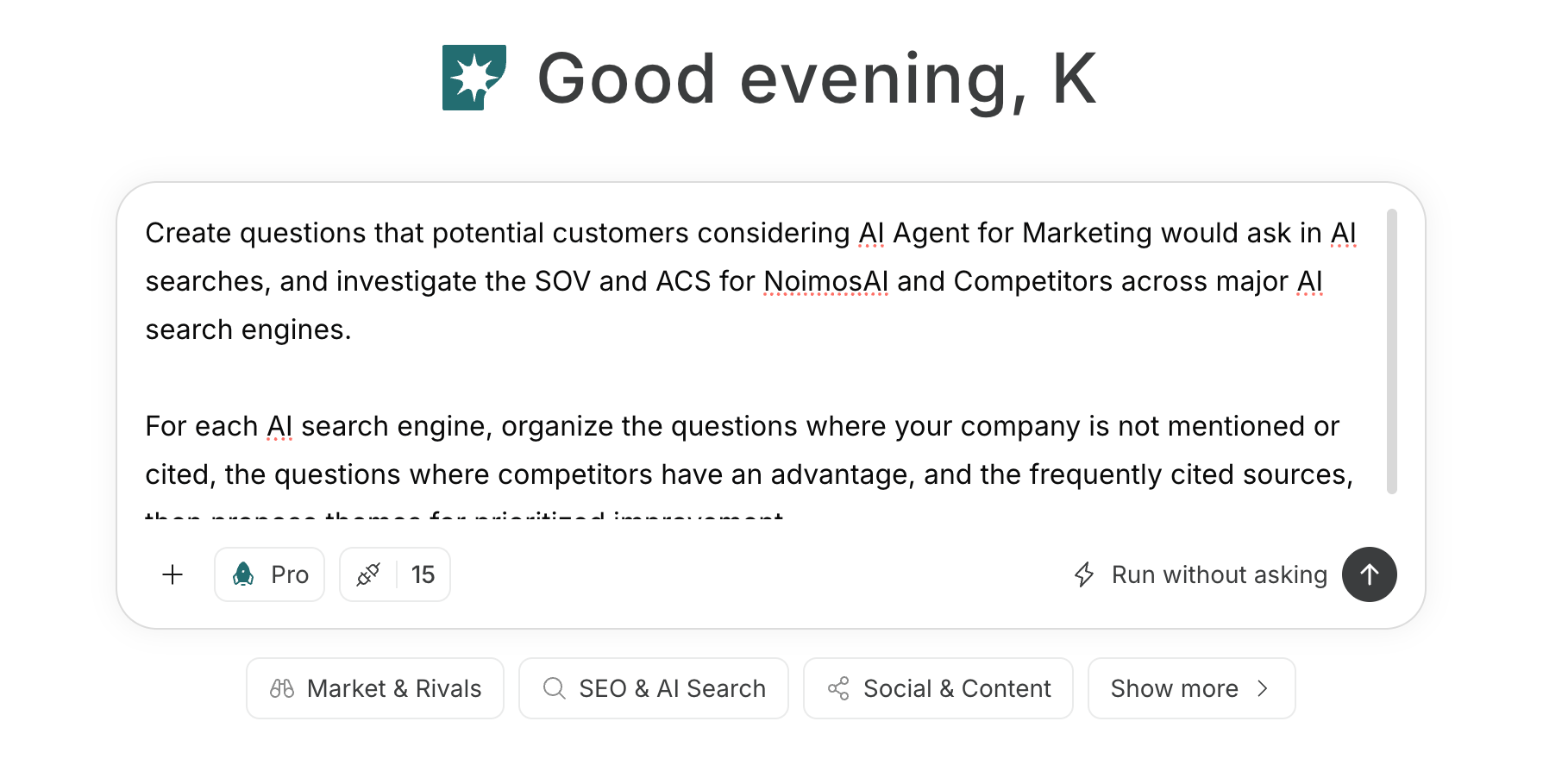
1. Investigate how you are introduced and cited in AI answers
First, craft questions your target audience would ask AI about your topic and check how similar authors and media are introduced. Organize not only whether you’re mentioned, but which expertise is attributed, what content is cited, and what information is missing.
Create questions that [target audience] would ask AI about [publishing topic], divided into basics, methods, comparisons, latest information, and selection of authors/media.For each question, investigate how [author or publication name] and similar authors or publications are presented and cited. Summarize the accuracy of each description, reasons for inclusion, cited sources and passages, and missing information.
In the investigation, check not just whether your name appears but what expertise you’re presented as, what content is cited, and whether it links to the original source. If you’re being confused with another publisher, prioritize fixing official profiles and author information.Prioritize questions that matter to your audience and that you can accurately answer with public information. Even if similar authors are introduced, deprioritize questions that are only tangential to your topics.
2. Standardize official information about authors and media
Audit your website and distribution channels to fix ambiguity, inaccurate descriptions, and missing information found in the previous step. Check how authors, creators, or publishers are named; how their expertise and experience are documented; and how editorial policy, authorship, and publication dates are displayed. Then create the pages and copy needed to correct the gaps.
Review [official website and distribution URLs]. Identify inconsistent, missing, or outdated information about author, creator, or publisher names; expertise; target audience; experience and credentials; editorial policy; authorship; publication and update dates; and the relationships among official channels. Specify the pages that need correction and provide publication-ready copy.
Prioritize pages where readers cannot identify the author or publisher, where the relationship between the author and content is unclear, where publication or update dates are missing, or where channels contradict one another. After fixing them, connect profiles, author pages, representative content, and official channels with internal links.
3. Publish original, evidence-backed content AI can cite
Choose one question that AI answers do not cover well and publish original research, experience, interviews, or test results as the primary source. Ask NoimosAI to structure the conclusion, method, results, interpretation, limitations, and sources into a final draft that readers can verify and AI answers can cite.
For [question or topic], create public content that AI and readers can reference as an original source based on [your research, experience, interviews, verification results].Include conclusion, research/verification methods, concrete results, interpretation, limitations, publish date/update date, verifiable external sources, and related content. Do not fabricate experiences, numbers, or quotes that were not provided.
Before publishing, verify research methods, period, figures, quotes, and external sources against the original material. Distinguish experience and opinion from facts, and note what the research did not determine or where conditions don’t apply.After publishing, ensure the answer is stated up front, headings let readers follow the argument, and tables/bullets include premises and units. Add internal links from relevant official profiles and past content so search engines and AI can discover the original source.
4. Monitor and improve mentions, descriptions, and citations
Monthly, check the same questions used in the initial investigation under the same conditions and compare changes in mentions, descriptions, and cited sources. Don’t stop at mention count changes—identify inaccurate descriptions and outdated citations, and create an agent that proposes official pages to update and concrete fixes.
For the same [list of questions to check in AI search] as last time, investigate how [author/media name] and similar authors/media are introduced, described, and cited. Organize mentions that increased or decreased since last time, inaccurate descriptions, newly cited pages, and outdated information, and suggest priority official pages to update along with concrete corrections.
Integrations: NoneFor questions with changes, compare not only increases or decreases in mentions but also accuracy of descriptions and cited sources. If you stop being cited, don’t mimic competitor wording—check whether the information needed in answers is present, whether your original source is discoverable, and whether update dates are visible.Fixes don’t always lead to immediate increases in mentions. Continue monitoring under the same questions, AI services, and conditions, and first confirm if official pages are being discovered, described, and cited correctly. If there’s no improvement, then check sequentially for missing direct answers, evidence, author information, and internal links.